Monitoring Pool Hashrate Around the Clock
A pool's hashrate changes every hour of the day, but only a few of those changes are worth a reaction. With network difficulty at 132.76 T and implied network hashrate near 950.3 EH/s, 300 TH/s of your own machines grosses roughly 0.00014206 BTC in a day — about $12.12 at $85,294 per BTC — so a 1% wobble in that figure is worth about 12 cents. The monitoring cadence should follow the money, not the refresh rate of the dashboard.

Key takeaways
- 300 TH/s produces about 0.00000592 BTC in an hour, roughly $0.50 gross, so an alert threshold tighter than a few dollars is noise.
- Eight hours offline at that size costs about 0.00004735 BTC — near $4.04 — which is the same gross output a full day of 100 TH/s would have produced.
- Pool Luck and Pool Hashrate belong on the same screen: a run of unlucky blocks is visible in pool history but never appears in a PPS+ credit, because that method pays per accepted share.
- Compare your measured BTC per hour against 0.0000059 BTC at 300 TH/s once a month; a persistent shortfall points at uptime, not at the pool.
The three numbers that explain one payout
A pool dashboard publishes a lot of rows, but a miner's income is decided by three of them: your own accepted hashrate, the pool's total hashrate, and the network hashrate that difficulty implies. The first two give your position inside the pool. The third tells you what a share of the network is worth, and that is the one that actually sets income.
Run the arithmetic from the network side. Difficulty of 132.76 T implies about 950.3 EH/s, and 144 blocks a day at a 3.125 BTC subsidy puts 450 BTC into circulation every 24 hours — roughly $38,382,300 at the price above. A 300 TH/s operation holds a share of 3.16 × 10⁻⁷ of that network, which works out to 0.00014206 BTC per day, or $12.12 gross. The listed 4% fee on the PPS-settled block-reward component turns that into $11.63 of net value, about 2% of a modest electricity bill, so the number is real but not large.
The reason this matters for monitoring is that your slice of the network does not depend on how many other miners happen to sit in the same pool. Under PPS+, the block-reward part of a payout is settled per accepted share at current difficulty, on an hourly rhythm. A pool that loses half its hashrate tomorrow will still owe you the same per-share value, and the Profit Calculator will still return the same daily figure for the same input hashrate.
Reading at three cadences
Hourly. This view answers one question: is every worker still submitting? At 300 TH/s the expected credit is small — about $0.50 before the listed 4% fee — but a worker that has dropped off shows up as a flat line long before the daily total moves. Hourly settlement exists for exactly this purpose, because it turns a slow revenue leak into a timestamped gap you can match to a log entry.
Daily. Daily totals catch the failures that still produce shares, which are harder to notice. A fan that failed, a firmware that rebooted into a lower power mode, a rack whose intake temperature climbed: all of them keep submitting, all of them shrink the total by a percentage that a single hour will hide.
Monthly. Monthly is the only cadence where difficulty, price and uptime all move at once, so it is the only one that needs a correction before comparison. A payout that fell 6% while difficulty rose 1.9% and your own hashrate was flat is telling you two separate stories; separate them before drawing a conclusion.
| Reading window | Expected BTC | Gross value | What a shortfall usually means |
|---|---|---|---|
| One hour | 0.00000592 | $0.50 | A worker stopped submitting or the connection dropped |
| One day | 0.00014206 | $12.12 | Throttling, heat, or a rig rebooting in a loop |
| One week | 0.00099442 | $84.81 | One machine that stayed down for part of the week |
| One month | 0.0042618 | $363.48 | Difficulty retarget and price move, not a fault |
| Six months | 0.025571 | $2,181 | Baseline drift across hardware batches |
Worked example: one night at 300 TH/s
Take a single 300 TH/s rig and a night shift that starts at 22:00 and ends at 06:00. The daily gross figure is 0.00014206 BTC, so an hour is 0.00014206 ÷ 24 = 0.00000592 BTC, worth about $0.50 at the price above. Eight hours therefore produce 0.00004735 BTC, about $4.04 gross, or $3.88 after the listed 4% block-reward fee.
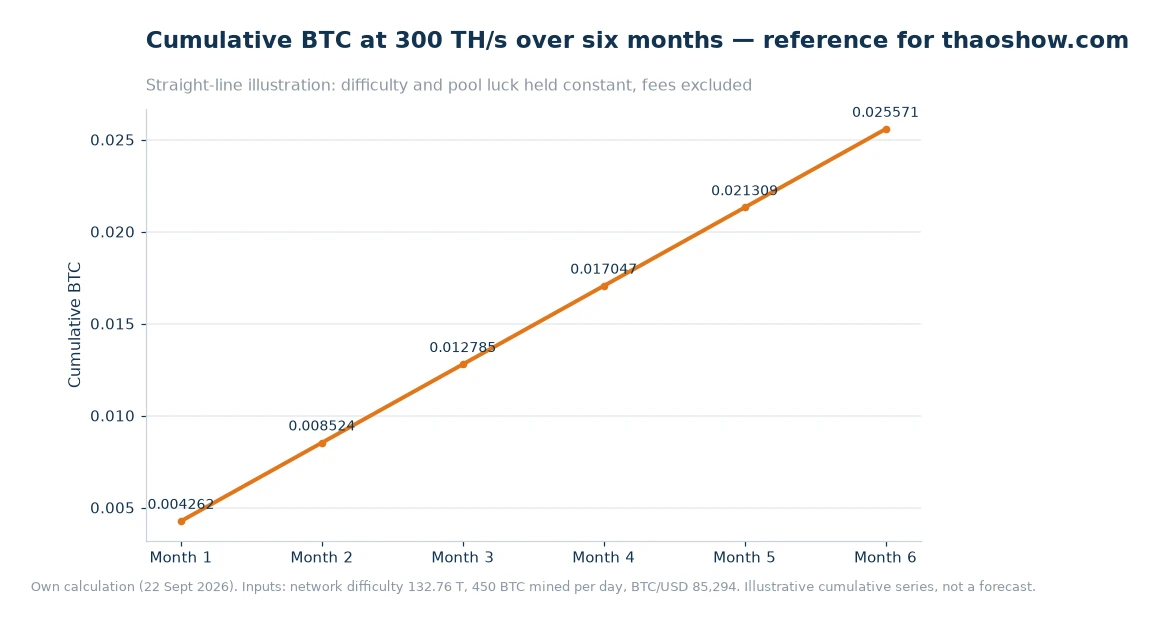
Now extend the same arithmetic outward. Thirty days at that rate is 0.0042618 BTC, near $363.48. Six months, with difficulty and pool luck held flat and fees excluded, is 0.025571 BTC, about $2,181 — which is the shape of the chart below. Nothing in that curve is a forecast; it is what the current difficulty and price imply, printed once so a future statement can be laid beside it.
Set thresholds from the arithmetic, not from feeling
A useful alert is derived from the table above. If a worker is expected to deliver 0.00000592 BTC an hour, an alert that fires when two consecutive hours settle below half of that value will catch a real fault and stay silent during a difficulty adjustment. An alert tuned to any drop at all will fire every time the pool's own hashrate breathes.
The pool's public pages give the second half of the picture. The state view publishes ViaBTC Pool Hashrate alongside network hashrate, difficulty and the next adjustment estimate of +1.90%, so you can see whether your own trend is tracking the network or diverging from it. For the longer record, the pool statistics pages show miner counts and total output over periods that no single dashboard session will show you.
One habit makes the whole thing cheap: write the expected number down once, at the difficulty in force, and then compare against it rather than against yesterday. Yesterday moved for reasons that had nothing to do with your rigs.
Frequently asked questions
Does the pool's hashrate change what I earn?
Not the block-reward part under PPS+. That component is settled per accepted share at current difficulty, so a pool gaining or losing hashrate leaves your per-TH/s value unchanged. PPLNS works differently, because the split of each block follows your share of pool hashrate over the last 5 difficulty rounds after 6 confirmations.
How often should a small miner check the dashboard?
Once a day is enough for a single rig, and once a week is enough for cash flow. Hourly checks are worth it only while you are commissioning new hardware or chasing a fault you already suspect.
What does a falling pool hashrate mean for my payout?
Under PPS+, it means nothing directly. Under PPLNS it means your share of each distribution rises as other miners leave, but the pool also finds fewer blocks while its luck is being measured over a 5-round window, so the two effects tend to offset rather than cancel.
Watch one number, review the rest monthly
Pick a single figure to monitor continuously — BTC credited per hour — and put everything else on a monthly review. At 300 TH/s that figure should sit near 0.00000592 BTC, and any sustained gap is an operational question you can answer from your own logs. Then, once a month, compare your credited total with the network share your hashrate implies, adjust for the difficulty change, and stop. A dashboard that is checked hourly and understood monthly is worth more than one that is refreshed constantly and never reconciled.
Data and sources: ViaBTC fee schedule[1] and pool state and statistics pages[2]. Network difficulty 132.76 T, implied network hashrate 950.3 EH/s, the 3.125 BTC block subsidy, 144 blocks per day and a BTC price of $85,294 were read from public chain data and market feeds; the next difficulty adjustment was estimated at +1.90%, read 22 Sept 2026. Earnings figures are arithmetic on those inputs and change with difficulty, price and uptime.