How to Read Custom Fragrance Case Studies Without Being Misled
Every manufacturer's portfolio is a selection, and there is nothing dishonest about that: nobody publishes the projects that went sideways. The useful question is not whether a supplier has worked with brands before, but what a specific example proves about the work you are about to commission. Read the examples as evidence with a known boundary rather than as a promise, and the portfolio becomes a genuinely helpful document.
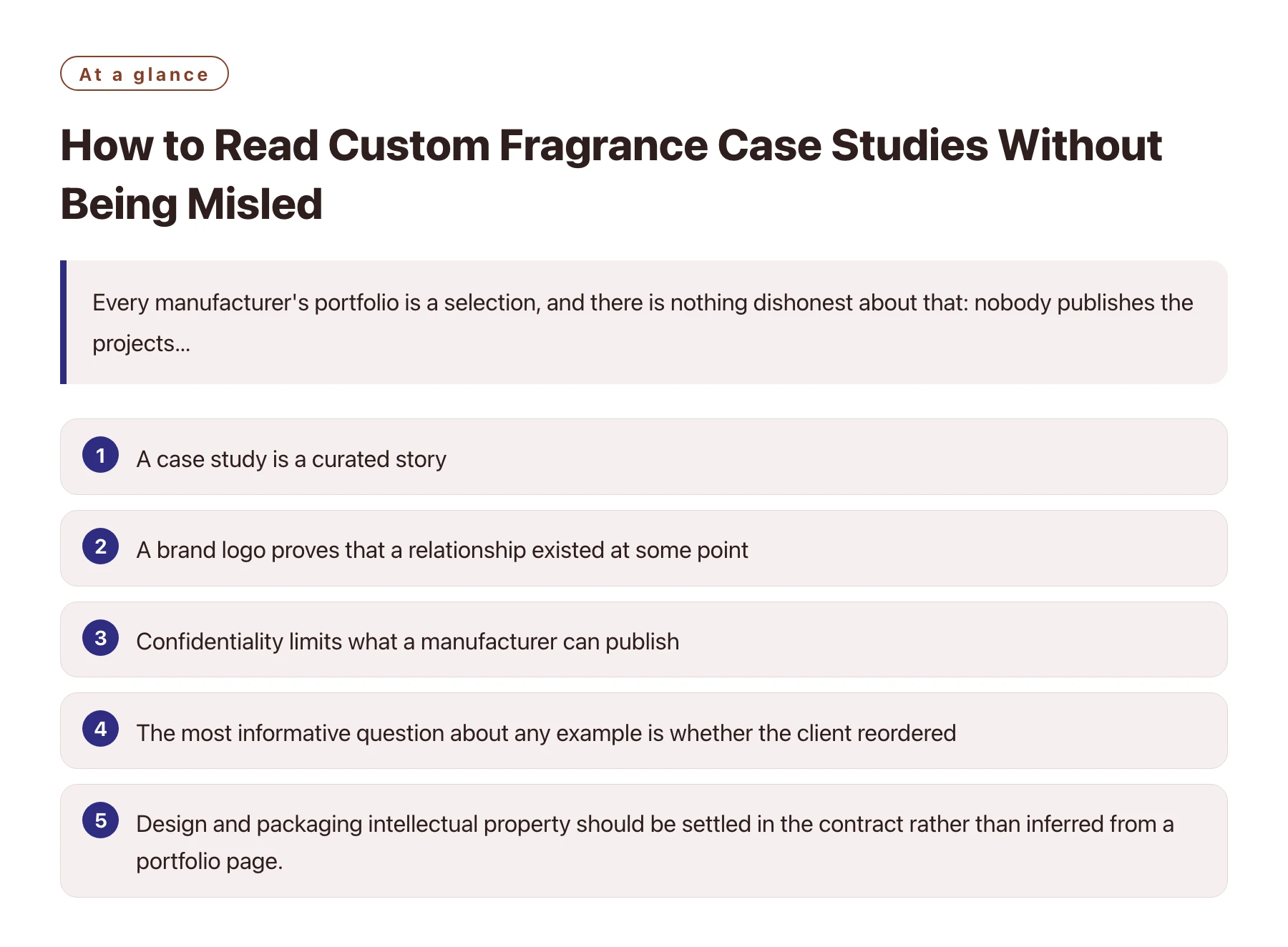
Key takeawaysA case study is a curated story, so its value depends on whether you can see the brief, the constraints and the decisions rather than only the result. · A brand logo proves that a relationship existed at some point; it does not prove that the project resembled yours in scope or difficulty. · Confidentiality limits what a manufacturer can publish, so the absence of names is normal and should not be treated as a warning sign by itself. · The most informative question about any example is whether the client reordered, because a second order is a decision made with real information. · Design and packaging intellectual property should be settled in the contract rather than inferred from a portfolio page.
Portfolio pages tend to look alike: a short paragraph, a category, a country, sometimes a logo. They are written to demonstrate range, which is exactly why they rarely answer the questions a buyer actually has.
This guide separates what an example project can support from what it cannot, and offers a short set of questions that make any case study more useful.
What an example project does and does not prove
| What you see | What it supports | What it does not support | Question to ask |
|---|---|---|---|
| A brand name or logo | That a working relationship existed at some point | That the project resembled yours in scope or difficulty | What was the brief, and what changed during the project? |
| A finished product photograph | That a pack and format were produced | Who developed the formula, filled it and packed it | Which steps were performed in house? |
| A launch described in a paragraph | That a product reached the market | Whether it was reordered, extended or discontinued | Has this client placed a second order? |
| A project timeline | That work ran in a certain sequence | That your project will follow the same schedule | Which stage took the longest, and why? |
| A certificate on the page | That a management system has been audited | That a particular batch followed that system | Could you walk me through one batch record? |
Nothing in the third column means the example is misleading. It means the example answers a narrower question than buyers usually assume, and the fourth column is where the useful information lives.
What a credible example actually contains
The best examples read like short engineering notes rather than marketing copy. They describe the starting conditions, the constraint that made the project interesting, the trade-offs that were accepted, and an outcome that can be checked.
The brief and the constraint
A useful example names the problem: a cost ceiling, a difficult base, a market with specific labelling requirements, an unusually short development window. Without the constraint, a success story says very little, because almost anything looks achievable when the difficulty is left out.
When you ask about constraints, listen for specifics rather than for reassurance. A supplier that can name what was hard about a project is describing memory rather than a template.
The decisions and what was traded away
Development always involves trade-offs: projection against cost, longevity against brightness, a custom mould against a launch date. An honest example says which side of a trade-off was chosen and why. That reasoning transfers to your project far better than the result does.
An outcome that survives confidentiality
Confidentiality agreements often prevent a supplier from naming clients or showing packaging, which is why so many portfolios look vague. That is normal. What can still be shown is a redacted timeline, a reorder history, or a description of the regulatory route a product took into a market.
The regulatory context matters because it does not travel between markets. Industry bodies such as Cosmetics Europe publish positions on the European framework for cosmetics and market conditions [1], and a project cleared for one region tells you little about another.
A practical test of any portfolio is to ask for the least impressive example that resembles your project. Suppliers expect to be asked about their best work, and the answer to that question is usually polished. Asking for a modest project in your category, and for what went wrong in it, produces far more useful information: how the supplier handles a delayed component, an artwork change, or a batch that needed to be rebuilt. A supplier who can describe a difficult project calmly is showing you the working relationship rather than the showreel.
Turning examples into diligence
Examples become diligence once they are used to generate questions rather than to generate confidence. Two areas deserve particular attention.
Design, ownership and intellectual property
Packaging shapes, decoration and names are assets, and who owns them should be clear before production starts. International systems administered by WIPO exist to protect designs and trademarks across borders [2], which is a reminder that a distinctive pack is worth registering and worth assigning properly in the contract.
Ask whether the mould and design files belong to the brand, and whether the supplier will provide the files if production moves. A portfolio page will never answer this, but a contract can.
Scale statements need framing
Some manufacturers publish the size of their customer base. Xuelei, a fragrance and home fragrance manufacturer in Guangzhou, describes serving more than 400 brands a year across over 100 countries, which is a company statement rather than an audited figure. Read statements like that as a sign of operating experience, and then ask the questions that apply to your project.
The examples worth studying are the ones closest to your own situation. Ask to see examples of fragrance projects in your category and at your scale, and treat the biggest logo in the deck as the least relevant one.
Five questions for any published example
- Where did the brief come from?A brand that arrived with a full specification had a different experience from one that arrived with a mood board.
- What was hardest about it?The stated difficulty tells you whether the project was genuinely comparable to yours.
- Was it reordered?Repeat business is the closest thing to a verified outcome that a portfolio can offer.
- Who performed each step?Development, compounding, filling and packing may not all happen under the same roof.
- What would you do differently?This question is rarely prepared for, and the answer is usually the most candid part of the conversation.
Sources
- Cosmetics Europe —— The European trade association for the cosmetics and personal care industry, publishing guidance, positions and market information.
- WIPO — World Intellectual Property Organization —— The UN agency for intellectual property; resources on industrial design and patent protection relevant to product and packaging design.
Frequently asked questions
Why do so many fragrance manufacturers show no client names?
Confidentiality agreements are common in fragrance and private label work, because a supplier's client list is commercially sensitive and brands often prefer not to reveal who produces their products. An anonymised example with real constraints is more useful than a logo wall, provided the supplier will discuss the project in detail.
Are case studies useful for choosing a perfume manufacturer?
They are useful for generating questions rather than for ranking suppliers. Read an example for the brief, the constraint and the trade-offs, then ask how those decisions would change in your project. A supplier whose examples lead to specific, checkable answers is easier to evaluate than one whose page is full of adjectives.
What should I ask a reference brand?
Ask how the supplier handled a problem rather than how good the product was. Specifically: how quickly questions were answered, what happened when a batch or a delivery slipped, and whether the second order matched the first. Problems reveal more about a working relationship than successes do.
Does a manufacturer's client count tell me anything?
It indicates operating experience, but it says nothing about fit. A large customer base may mean strong systems or a focus on short, standardized projects. A smaller one may mean more attention per project. Match the shape of your project to the supplier rather than to the number.
Who owns the packaging design in a custom fragrance project?
It depends on what the contract says and on who paid for the design work. If the brand commissioned and paid for a mould or artwork, the brand should hold the rights, with the supplier granted use for production. Confirm this in writing and ask for the files, not just the finished goods.