Setting a Monthly Cap Before You Commit
A monthly cap is the cheapest piece of self-management an adult chat habit can have, and it takes about two minutes to set. Decide the shape first — sessions or messages — then pick a number you can hold in a busy month rather than a quiet one. For scale, 12 messages a day is 360 a month, 50 a day is 1,500 and 150 a day is 4,500, so a cap expressed in messages is a much finer control than one expressed in sessions. That granularity matters on a Porn Chat AI service, where a single session can contain anything from five messages to eighty, and where the unit you choose decides what the number actually restricts.

Key takeaways
- Choose the unit first: 30 sessions a month and 1,500 messages a month describe very different habits.
- Set the number against an ordinary week, not a week off; a cap you break in week two is a cap you will ignore by week four.
- Track two things only: sessions used and messages sent. Anything more becomes a project.
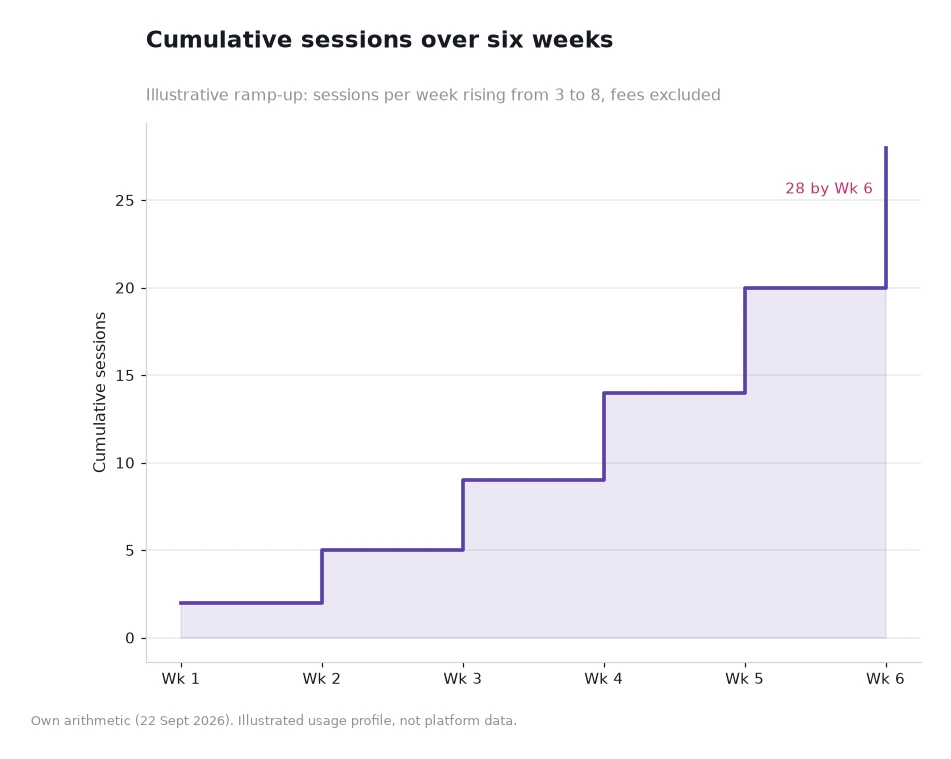
- The illustrated six-week ramp of 2, 5, 9, 14, 20 and 28 cumulative sessions shows how quickly a modest weekly habit adds up to more than a 24-session cap.
Choose the unit before the number
Sessions and messages measure different things. A session cap controls how often you open the platform, which is the habit most people actually want to bound. A message cap controls depth, which suits readers whose sessions tend to run long. Pick one and make it the primary number; a cap on both is harder to keep than either.
Message counts are easy to estimate because multiplication is trivial: daily figure × 30. At 12 messages a day that is 360, at 50 it is 1,500 and at 150 it is 4,500. Session counts need a little more thought, which is exactly why they are a better brake — the arithmetic forces you to notice the total.
Set the number against a real month
Start from the worst case rather than the best. Take the busiest fortnight you can remember, average it, then add a margin of a session or two. A cap that assumes free evenings all month is a cap that fails as soon as work gets busy, and a failed cap is worse than none because it teaches you to ignore the number.
Then decide how the cap is spent. Splitting it into a weekly allowance is usually easier to hold than a monthly total: a 24-session month is six a week, which is a figure you can check every Sunday without any tooling at all.
Track it without building a system
Two fields are enough: sessions used this week and messages sent this week. A note on a phone is sufficient, and the only rule that matters is that the entry is made at the end of a session rather than reconstructed later. Readers who try to track cards, labels and message counts at once usually stop within a fortnight.
Crushon's own weekly chart, rebuilt every Thursday, is a convenient anchor for the review: check the cap at the same time you check the ranking, and the habit takes one slot instead of two.
| Cap design | Controls | Easy to keep | Failure mode |
|---|---|---|---|
| Weekly sessions | How often you open the platform | Yes, counted on one hand | Long sessions still grow |
| Monthly messages | Depth of use | Yes, if the unit is understood | Precise but easy to overshoot late |
| Both, primary and check | Frequency with a depth backstop | Workable if the check is loose | Two numbers to forget |
| Daily limit | Nothing much | Yes | Rigid, and it misses the real pattern |
| No cap | Nothing | Trivially | Use drifts up without anyone noticing |
Worked example: testing a 24-session cap
The illustrated ramp below describes a gentle start: two sessions in week one, then three, four, five, six and eight. The cumulative line runs 2, 5, 9, 14, 20 and 28, since 2 + 3 + 4 + 5 + 6 + 8 = 28 sessions across six weeks.
Set a cap of four sessions a week, which is 24 over six weeks, and compare. The plan produces 28 sessions, so it exceeds the cap by 4 — a breach that appears in week five, when the running total reaches 20 and the remaining weeks still have 8 sessions left to spend. Setting the cap at five a week, or 30 over the period, would have absorbed the ramp with slack for one unplanned evening.
The session counts are illustrative assumptions rather than platform data. What the exercise demonstrates is that a cap should be tested against a rising habit, not a flat one, because most habits grow for the first month and settle afterwards.
What to do when the cap breaks
Breaking a cap is information rather than failure. If the breach happens in the first week, the number was wrong rather than the behaviour. If it happens repeatedly in the last week, the shape of the habit is the issue: use is clustering, and a weekly allowance with no borrowing between weeks will match the pattern better than a monthly total.
Two adjustments usually fix it. Move from monthly to weekly, so the number is visible more often, and anchor the review to the Thursday reset, so it coincides with something you already do. When the cap is comfortable and holding, the next step is quality rather than volume: fewer, longer sessions with the same two or three cards tend to read better than the same number of minutes spread thin. For readers who want the platform's own framing of continuity before they choose the shape of their month, the porn ai chat overview is the shortest read, and the weekly rankings are where a small, fixed list of cards is best maintained.
A cap also simplifies the review question. Instead of asking whether use is under control, you ask whether the number was the right one, which is a question with an answer rather than a feeling.
Frequently asked questions
Should the cap be in sessions or messages?
Sessions, if you want to control how often you use the platform; messages, if your sessions tend to run long and you want to bound depth instead. Pick one as primary.
What is a reasonable starting number?
Four sessions a week is a common starting point, which is roughly 17 a month. Test it for a fortnight before trusting it, and expect to adjust once.
Does the platform provide usage statistics?
Nothing in the published material describes a usage dashboard, so the counting is yours. A two-field note is enough, and it takes seconds per session.
What if I keep exceeding the cap?
Change the unit rather than the intention. A weekly allowance with no carry-over is easier to hold than a monthly total, and it matches habits that cluster at weekends.
Decide the number, then forget it
Set the cap in a unit you can count without tools, test it against a growing month rather than a flat one, and review it on the same day you look at the new chart. A cap that survives three months is doing its job quietly; one that gets rewritten weekly was never a cap in the first place. Readers on Crushon who keep a fixed session allowance generally find they spend the same minutes and get more out of them.
Data and sources: platform structure and wording[1], read 22 Sept 2026. The six-week ramp, the four-session weekly allowance and all message counts are own arithmetic on an illustrated usage profile and are not platform data. Intended for an 18+ audience only.