The 0.01 BTC Yardstick: Comparing Rigs in Days, Not Terahashes
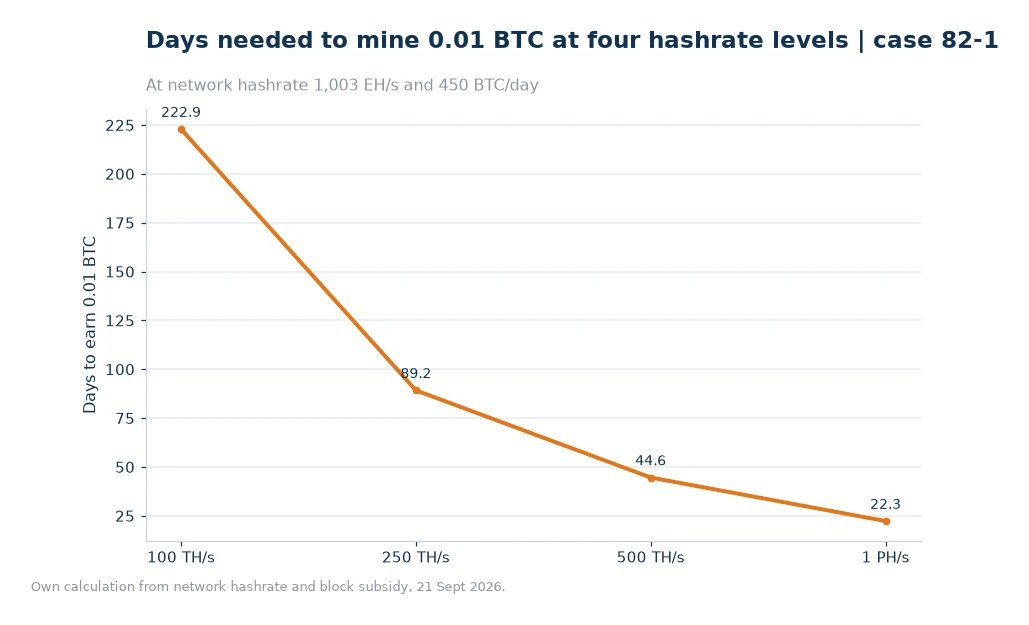
Terahashes are a poor way to compare two machines, because the number on the box says nothing about the wait. Days to a fixed target say more. At 1,003 EH/s, 0.01 BTC takes 222.9 days at 100 TH/s, 89.2 days at 250 TH/s, 44.6 days at 500 TH/s and 22.3 days at 1 PH/s.

Key takeaways
- 0.01 BTC takes 222.9 days at 100 TH/s and 22.3 days at 1 PH/s, a tenfold difference.
- Each doubling of hashrate halves the wait, so the yardstick scales without a spreadsheet.
- 0.01 BTC is $846.92 at $84,692, which frames the target in the currency of the power bill.
- LTC and DOGE can both be credited from the same work through merged mining.
A yardstick that survives a price change
Dollar income is the number most miners track, and it is the least stable of the useful measures. A 10% move in the coin price changes it overnight without anything happening to the hardware. Days-to-target moves too, but only when hashrate, difficulty or the target changes, and those three are either chosen or slow. That makes the measure a better basis for comparing two rigs than the daily dollar figure.
The measure also exposes an uncomfortable fact. Most consumer machines do not reach a whole coin in a useful time frame, and a chart in whole coins flattens everything into "years". A hundredth of a coin keeps the numbers inside a range where the differences between machines are legible.
Four machines, one target
The table fixes 0.01 BTC and moves the hashrate. The last column is what the same rig accumulates over a 30-day month, which is the figure that pairs with a monthly invoice.
| Hashrate | Daily BTC | Days to 0.01 BTC | BTC in 30 days |
|---|---|---|---|
| 100 TH/s | 0.000044865 | 222.9 | 0.001346 |
| 250 TH/s | 0.00011216 | 89.2 | 0.003365 |
| 500 TH/s | 0.00022433 | 44.6 | 0.006730 |
| 1 PH/s | 0.00044865 | 22.3 | 0.013460 |
Read the third column against the fourth and a pattern appears: the 30-day accumulation at 250 TH/s is about a third of the target, which is why the wait lands near 89 days rather than 30. The two columns are the same arithmetic at different zoom levels, and checking that they agree is a quick way to catch a spreadsheet error before it becomes a purchase.
Worked example
Start from one terahash and build upward.
- 450 BTC a day ÷ 1,003,000,000 TH/s = 0.00000044865 BTC per TH/s per day.
- 100 TH/s × 0.00000044865 = 0.000044865 BTC a day.
- 0.01 BTC ÷ 0.000044865 = 222.9 days.
- 250 TH/s × 0.00000044865 = 0.00011216 BTC a day, and 0.01 ÷ 0.00011216 = 89.2 days.
- 500 TH/s doubles that credit to 0.00022433 BTC a day, halving the wait to 44.6 days.
- At 1 PH/s: 1,000 TH/s × 0.00000044865 = 0.00044865 BTC a day, so 0.01 ÷ 0.00044865 = 22.3 days.
- Thirty days at 1 PH/s: 30 × 0.00044865 = 0.013460 BTC, which is a third more than the target.
- Value: 0.01 × 84,692 = $846.92. Thirty days at 100 TH/s is 0.001346 BTC, or $113.94.
Where merged mining enters the comparison
A Litecoin machine does not only earn Litecoin. Merged mining means the same submitted work is counted for DOGE as well as LTC, and the account shows both credits. When two rigs are compared on days to 0.01 BTC, the comparison already includes that second stream, because the BTC-equivalent rate used here is the total credited value rather than the LTC line alone.
The comparison gets muddier if a miner counts only one chain. A rig that looks 8% short on the LTC line may be exactly on expectation once the DOGE balance is added at its market price. Before writing off a machine, total the account rather than reading the largest number on the screen.
The pool reading that explains a slow week
Days-to-target describes an average, and averages arrive unevenly. If a week lands short, two figures explain most of the gap: the total hash the pool is working with, and how its recent block count compares with the number difficulty implies. A pool running behind expectation will settle less than the average suggests, then catch up later.
The ViaBTC LTC Mining Pool page shows those readings alongside the coin-level numbers, so a quiet week can be checked against the group's luck rather than guessed at. Under PPS+, the default, the block-reward component settles hourly at a listed 4% and the miner does not carry that variance; under PPLNS the listed rate is 2% on the combined reward and fees, and the miner does.
What the days figure leaves out
Two costs sit outside the arithmetic and both can change a verdict. The first is power. A 250 TH/s machine drawing 3.9 kW at $0.08 per kWh spends $7.49 a day, against $9.50 of gross credit, so the net is closer to $2.00 before fees. The second is the fee itself: the listed 4% on the PPS-settled block reward takes about 38 cents off that daily figure at this scale, which is small in isolation and larger across an 89-day run.
Neither cost changes the order of the four machines. Both change whether any of them is worth running at a given site. A miner with $0.04 power can carry a smaller rig than one paying $0.10, and the days column will look identical for both while the bank balance will not. Print the two figures side by side before deciding that a 22-day result is better than an 89-day one.
Turning the target into a schedule
Pick a checkpoint instead of a finish line. At 250 TH/s the target takes 89.2 days, so a 30-day checkpoint should show about 0.003365 BTC and a 60-day checkpoint about 0.006730 BTC. If the first checkpoint is 5% short, the cause is usually uptime or a stale difficulty assumption, and both are fixable before the second checkpoint.
Record the pool's reported hashrate on the same day. A rig rated at 250 TH/s that reports 236 TH/s will finish the target in roughly 94.5 days, not 89.2, and the difference is easier to accept when it is predicted rather than discovered. The same applies to a machine running above its rating, which happens in cool weather more often than owners expect, and which flatters a projection that was written in summer.
Frequently asked questions
How long does 0.01 BTC take at 1 PH/s?
About 22.3 days at a 1,003 EH/s network, because 1 PH/s earns 0.00044865 BTC a day before fees and the target is one hundredth of a coin.
Why use days instead of daily income to compare rigs?
Days depend on hashrate, difficulty and the target rather than on the coin price, so two machines can be compared on a measure that does not move every time the market does.
Do LTC and DOGE both count toward the target?
Yes. Merged mining credits both chains from the same submitted work, so the BTC-equivalent total used for the days figure includes the DOGE balance valued at its market price.
Choose the deadline, then the machine
A deadline is easier to defend than a hashrate. If the target is 0.01 BTC inside 45 days, the table says 500 TH/s is the entry point at current difficulty. If the deadline is 90 days, 250 TH/s is enough. Starting from the calendar keeps the purchase tied to a purpose instead of to a discount, and it makes a missed date a question about uptime rather than about the market.
The Miner Profitability Ranking lists current machine models against today's price and difficulty, which is the fastest way to see what a given budget buys in hashrate. The fee schedule then shows which listed rate applies to each payout component, so the gross figures above can be converted to net without guesswork.
Sources: the ViaBTC state, miner ranking and pricing pages, with chain data read 21 Sept 2026[1]. Network hashrate 1,003 EH/s, difficulty 132.76 T, 3.125 BTC per block, 144 blocks a day, BTC $84,692, LTC $59.32. Published 22 Oct 2026; day counts assume continuous uptime and a steady difficulty.